Load profils, generated by smart meters (Linky for residential properties), are a strategic tool for understanding the energy dynamics of a site.
The energy transition and cost pressures require businesses and local authorities to conduct detailed analyses of consumption profiles.
Generally, this data is provided by DSOs such as Enedis or Local Distribution Companies (ELDs), particularly through CARD contracts.
They are also available on the websites of energy suppliers (EDF, Engie, Total Énergies, Alterna, etc.) along with consumption data.
The profils show the power demand over time, with short measurement intervals (10 to 30 minutes), providing the granularity required for control purposes.
With this information, it becomes possible to identify peaks and optimise contracted power.
In an environment where APIs and digital platforms facilitate data collection and integration, controlling load profils is key to transform raw data into energy performance.
What is a load profil?
A load profil represents the evolution of the power demand of a site over a given period.
It consists of measurement points recorded at regular intervals. As standard, these points are recorded every 10 or 30 minutes, but sometimes much more frequently.
Technical characteristics of a load profil
- Time granularity: The shorter the measurement interval, the more accurately the curve reflects consumption variations. For example, an interval of less than 10 minutes makes it possible to detect machine start-ups or production cycles.
- Measured parameters: Active power (kW), sometimes reactive power (kVAR), cumulative energy (kWh), voltage and current for more detailed analysis.
- Data format: profils are generally provided in CSV files or via API, with precise timestamps and standardised values.
How can I access my load profils?
Access to load profils depends on the type of energy and the grid operator.
For electricity, data is generally provided by Enedis via the Enedis Connect portal or via API.
Smart meters such as Linky enable automatic meter readings with a granularity of 10 or 30 minutes.
Conditions for accessing load profils
- Customer consent: The customer’s consent is required for the provision of data.
- Secure authentication: access must be via credentials or certificates to ensure confidentiality.
- Available formats: CSV, XML or API feed for integration into tracking tools.
Other sources of access to load profils
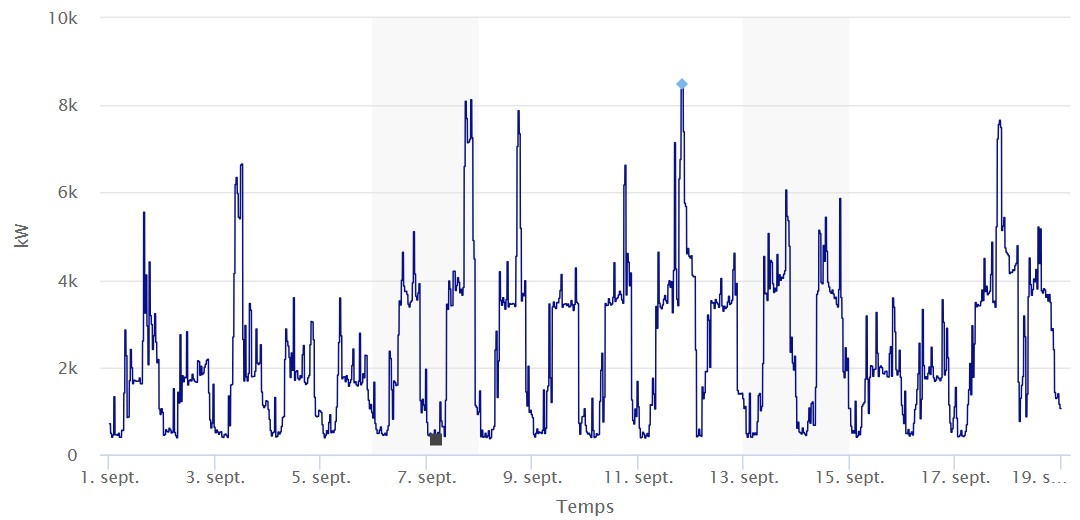
In general, electricity or gas suppliers also offer portals or web services that allow you to retrieve load profils in addition to your electricity bill. These often include tariff indicators.
These portals generally feature a graphical representation of the load profil. The x-axis represents time (in hours or days) and the y-axis represents electricity consumption or electrical power. In the latter case, the load profil is referred to as a power profil.
For large accounts, data hub solutions or IoT platforms can aggregate this multi-energy data.
What does load profil analysis enable?
Load profil analysis is much more than just visualisation. It is a strategic tool for implementing targeted actions:
Peak detection and clipping
The profils enable periods of high demand to be identified, which are often responsible for additional costs linked to exceeding the contracted power supply.
By anticipating these consumption peaks, we can apply peak shaving or load shedding strategies.
Optimisation of contracted power
By analysing the maximum power demand, it becomes possible to adjust Grid tariff subscriptions to avoid paying for unnecessary kVA.
This optimisation is particularly relevant for industrial or tertiary sites with high load variability.
Adjustment of uses and planning
The profils reveal electricity consumption profiles: simultaneous start-ups, production cycles, off-peak periods.
This information can be used to reprogram equipment, shift certain consumption to off-peak hours, and implement load shedding to smooth the curve.
Multi-site visualisation, comparative analysis and aggregation of load profils
For multi-site businesses, comparative analysis of profils highlights performance gaps, anomalies and opportunities for improvement.
But beyond comparison, the concept of aggregation is essential. It involves grouping data from several sites or meters to obtain a consolidated view.
This approach enables:
- To manage overall consumption at group or regional level.
- Identify collective optimisation levers (coordinated load shedding, power sharing) to save energy.
- Simplify the management of multi-site contracts by centralising key indicators.
Advanced forecasting and control using load profils
The analysis of load profils is not limited to observation. It paves the way for predictive models based on advanced algorithms.
By exploiting historical data and contextual variables (weather, calendar), these algorithms enable:
- Forecasting short- and medium-term consumption and production to anticipate energy needs.
- Coupling with local production and collective self-consumption to adjust consumption in real time and reduce carbon impact.
- Simulated scenarios to test the effect of operational changes before they are implemented.
These analyses not only reduce costs, but also contribute to the energy transition by limiting unnecessary consumption. Available formats: CSV, XML or API feed for integration into monitoring tools.
Altsis Opera Solution: Leveraging your load profils
At Altsis, we transform your data into performance drivers.
Our solutions automatically integrate load profils via API, offering intuitive graphical visualisation and advanced features:
- Profil manipulation: affine transformation, power or energy distribution, temporal projection.
- Complex aggregations based on criteria
- Production forecasting algorithm
- Automated export and detailed reports.
But the benefits don’t stop there. For Distribution System Operators (DSOs), aggregating and analysing load profils is essential for complying with regulatory obligations and supervising the network.
So, thanks to our tools:
- DSOs can anticipate local constraints and plan investments.
- They have a reliable tool to meet the obligations imposed by the CRE.
Load profils: a truly strategic tool
Load profils are much more than just an indicator. They are a valuable strategic tool for improving the energy efficiency and operational performance of DSOs.
Ready to leverage your data?
Contact Altsis for a demonstration of our solutions today.